Compressor · included in the subscription
The Astrassor: the one that overdoes it when you ask
Five characters on a single switch: truly clean at 1:1, firmer and firmer at 4:1, 10:1 and 20:1, and NOVA, which pushes so hard it overshoots. Two harmonic distortions to dirty it up when the track calls for it, and filters you can send to the detector or to the audio.
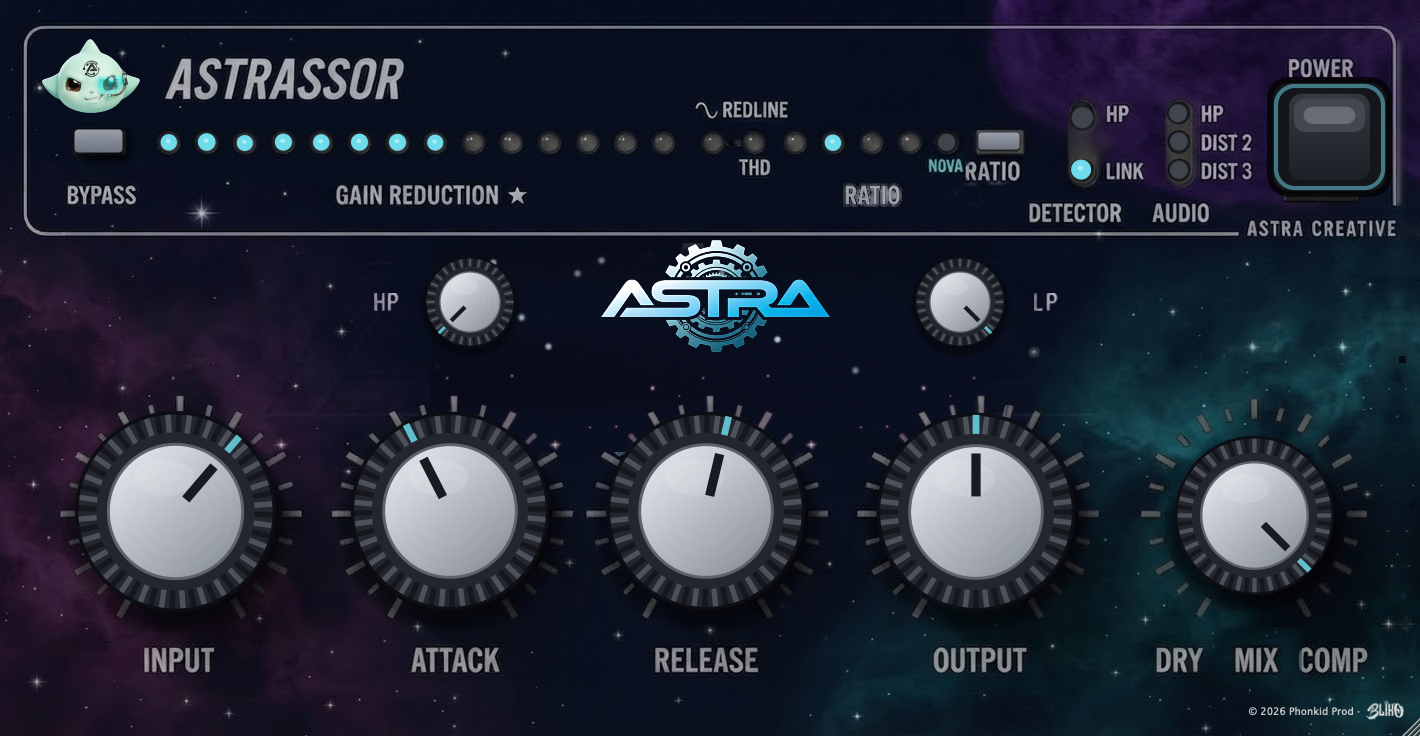
It joins the Astra Sampler FX subscription — if you're already in, it's yours without paying a cent more.
What it does
There is no threshold to set: the point where it starts working is fixed. You decide how much it compresses with the INPUT — the more you drive it, the harder it squeezes — and you win the level back with the OUTPUT. The RATIO chooses how much and how: 1:1, 4:1, 10:1 OPTO, 20:1 and NOVA.
1:1 doesn't compress at all: it's the setting for using it just for its colour. 10:1 OPTO releases in two stages, a fast one and one that follows the RELEASE knob, like an optical compressor. And NOVA is something else: past the threshold, every extra decibel going in brings a little less out. It pushes so hard it overshoots, and that excess is exactly the effect.
DIST 2 and DIST 3 add harmonics: DIST 3 only odd ones; DIST 2, even ones too. The HP (20 Hz to 1 kHz) and LP (1 to 20 kHz) filters can go to the detector, so an 808 doesn't make the mix pump, to the audio, or to both. LINK makes both channels compress together. And MIX, from DRY to COMP, gives you parallel compression without taking the plug-in off the channel.
What you get
It's included in the subscription. Not a separate purchase: anyone with Astra Sampler FX has it, and the subscription price doesn't go up because of it.
Why try it
Because we publish what we measure. These figures come from our test bench, which runs the same engine you download.
No look-ahead and no oversampling: what goes in comes out at the same instant, so nothing shifts in the mix.
The slopes come out exact: 4.00:1, 10.00:1 and 20.00:1, measured with the input between −12 and 0 dBFS, past the knee.
Negative on purpose: as the input rises from −12 to 0 dBFS, the output drops 0.7 dB. That's why we say it overshoots.
Without DIST, harmonics two to eight stay below −120 dBc. The clean path adds nothing: the colour is yours to add.
With the detector filter at 300 Hz and a 50 Hz 808 playing, gain reduction drops from 39.7 to 22.0 dB: the low end stops running the compression and comes out 16.6 dB more intact. And all of this costs 0.3% of one core at a buffer of 64, in stereo, with the distortion and the filters on.
Where we don't win
It isn't a peak limiter. With zero latency it can't see the hit coming: even with the fastest attack, the first transient gets over the top before it has fully reacted. If nothing may go past a ceiling, put a limiter after it.
The distortions aren't subtle. With a hot signal — a 1 kHz sine with 18 dB of INPUT — DIST 3 puts the third harmonic about 10 dB below the fundamental. Use them on purpose, or blend them in with the MIX.
Formats and requirements
macOS: VST3 and Audio Unit, universal binary (Intel and Apple Silicon),
macOS 11 or later.
Windows: 64-bit VST3, Windows 10 or later. Mono and stereo, any sample
rate.
A heads-up: the installers aren't signed with a paid certificate, so macOS will say it can't verify the developer and Windows may show a SmartScreen warning. On macOS you approve it in System Settings → Privacy & Security; it's explained step by step on the download page.