FET limiter · included in the subscription
The A-76: the one that doesn't hide
A solid-state FET limiter, the late-sixties kind: the one you don't reach for so it goes unnoticed, but so that it is noticed. It grabs fast, it distorts while it grabs, and that is exactly why people use it.
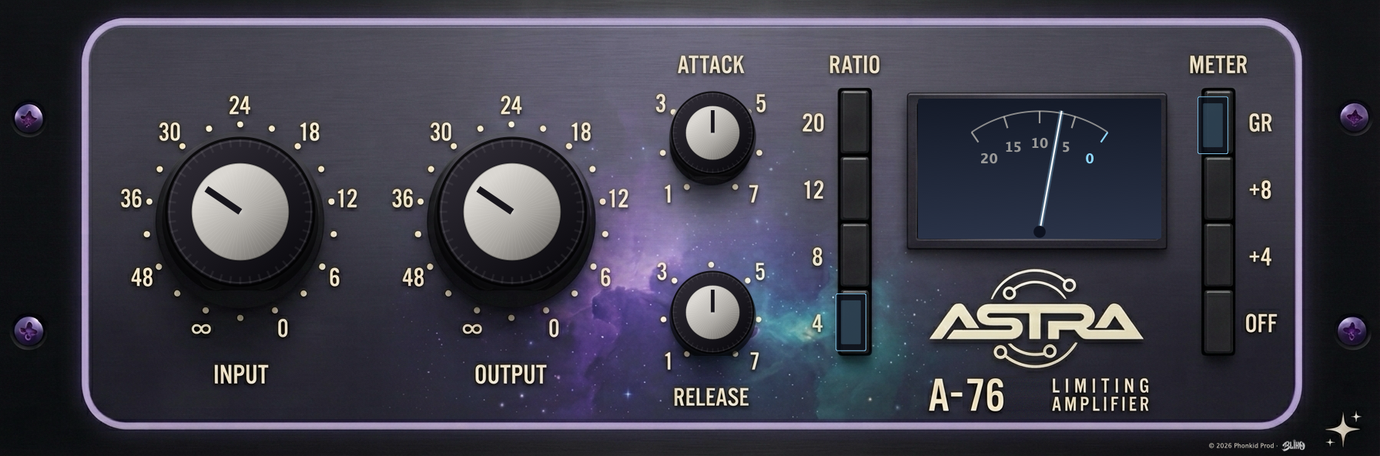
It comes with the Astra Sampler FX subscription — if you're already in, it's yours at no extra cost.
What it does
This box has no threshold, and that isn't an oversight: it is how it is built. You compress by driving it with INPUT and you make up with OUTPUT. Adding a threshold would be more convenient and would kill the character, so it doesn't have one.
Two things throw people off the first time, and both are like that on the original: attack and release run backwards — 7 is the fastest, not the slowest — and the detector reads the output, not the input. That last one changes the shape of the curve: you have to pre-compensate the slope or the ratios come out at a third of what they say.
And there is the all-buttons-in mode, which isn't a trick: it is one more ratio, with a bent knee, a slower attack and a lot more distortion. It is the setting people buy one of these for.
What you get
It is included in the subscription. Not a separate purchase: if you have the Astra Sampler FX you have this, and the subscription price does not go up for it.
From 26 October it can also be bought on its own, for anyone who only wants the compressor.
Why try it
Because we publish what we measure. These figures come from our own bench, on the same build you download, and next to each one is what the box it models does, so you can see where it gets close and where it doesn't.
With the knob at 7, which is the fastest and not the slowest. The original's spec sheet says 20 µs.
With 8x oversampling, on an 11 kHz tone compressed at 20:1 with the fastest attack. Without oversampling it would be −42.6.
Six samples, and 8x oversampling adds none. The filter is polyphase IIR rather than linear-phase FIR: in a compressor latency matters more than phase.
The original's is 0.95. On the other three ratios it comes out 0.74 · 0.87 · 0.91 against 0.75 · 0.88 · 0.92.
The slowest attack, knob at 1, gives 807 µs against the original's 800. And all of this costs 2.1 % of one core at a 64-sample buffer: 8x oversampling costs twice what 4x does, drops aliasing 36 dB further, and is still cheap.
And where we don't win
Our fastest attack lands at 26 µs and the original's sheet says 20. That is six microseconds and nobody is going to hear them in practice, but it isn't spot on and we are not going to say it is.
And a methodological note worth understanding: that attack is measured at 192 kHz. At 48 kHz one sample lasts 20.8 µs, so a 20 µs attack doesn't even fit in a single sample — any figure published from a 48 kHz measurement would be made up.
The second harmonic sits at −55 dBc on purpose. That is not a defect that got past us: it is the FET's colour, which is exactly the point. What oversampling is chasing is the absence of aliasing, not the absence of harmonics.
Formats and requirements
macOS: VST3, Audio Unit and standalone application, universal binary (Intel and
Apple Silicon), macOS 10.13 or later.
Windows: 64-bit VST3, Windows 10 or later. Mono and stereo, any sample rate.
One heads-up: the installers are not signed with a paid certificate, so macOS will say it cannot verify the developer and Windows may warn via SmartScreen. On macOS you approve it in System Settings → Privacy & Security; it is explained step by step on the download page.