Optical leveller · included in the subscription
The A-3A: the leveller you don't hear working
A T4 optical leveller: the one you put on a vocal to hold it still without it sounding like anything is there. It joins the Astra Sampler FX subscription — if you are already in, it is yours at no extra cost.
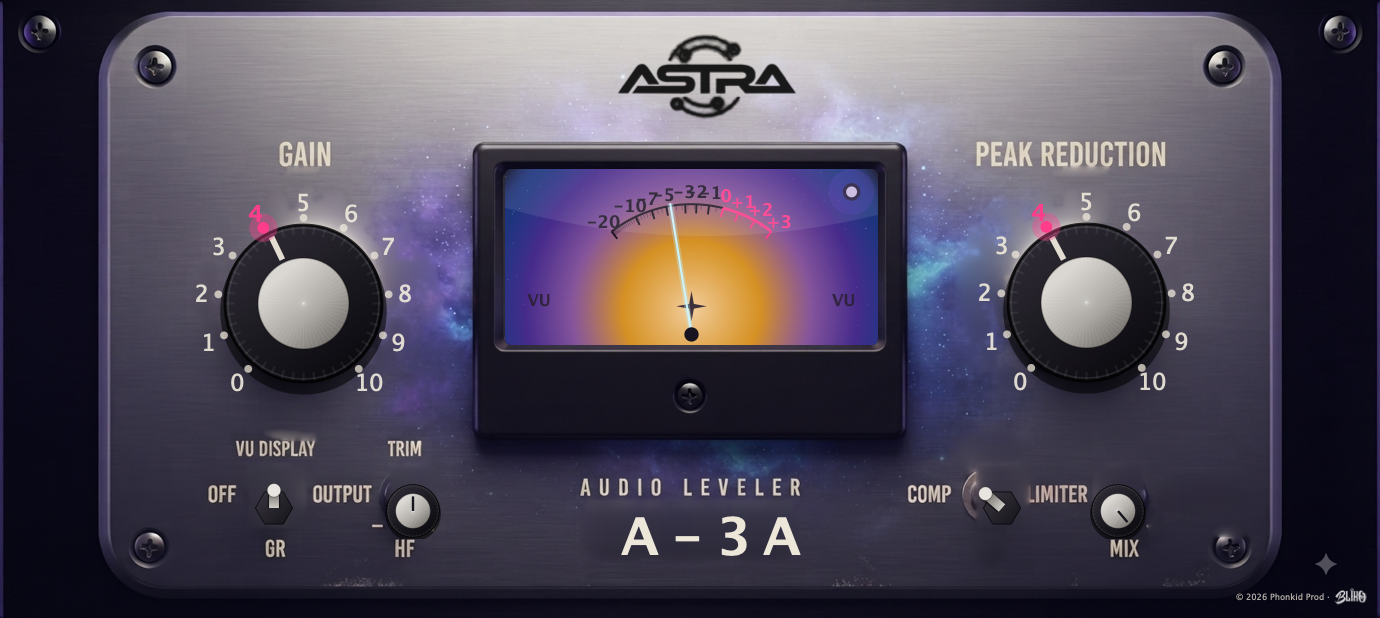
What it does
An optical leveller has no threshold: it has a photocell that darkens the more signal reaches it. So there is no point where compression "kicks in", just a curve that closes gradually. What is modelled here is that physics, not an approximation with fixed attack and release: the release runs in two stages and has programme memory, so the longer it has been working, the slower it lets go.
Two knobs and that is it: PEAK REDUCTION, how hard it squeezes, and GAIN, how much it gives back. The COMP / LIMITER lever changes the whole character, and HF sets how much the detector listens to the top end — turn it up and it tames sibilance without darkening the sound.
What you get
It is included in the subscription. Not a separate purchase: if you have Astra Sampler FX you have this, and the subscription price does not go up for it.
From 28 September it will also be sold on its own, for anyone who only wants the compressor.
Why try it
Because we publish what we measure. These figures come from our own bench, on the same build you download, with the hardware it models right next to them — so you can see where it gets close and where it does not.
Measured between −12 and −6 dBFS. The hardware it models does ~3:1. Spot on.
To 63 % of peak. The original's spec sheet says 1.5 ms or less.
The lever turns it into a real limiter, not just a slightly higher ratio.
The second stage takes this long to let go of 90 %. That is what makes it breathe.
And where we don't win
Our first-stage release measures 85 ms and the original sits at 60: it lets go a touch slower than it should on very fast material. And the saturation leaves a 1.94 % half-cycle asymmetry — small, but not zero, so on very clean passages it adds a little character the original would not.
We say it because the whole bench travels with the press kit: anyone can repeat these measurements and find the same.
Formats and requirements
macOS: VST3, Audio Unit and standalone app, universal binary (Intel and Apple Silicon), macOS 10.13 or later. Windows: 64-bit VST3, Windows 10 or later. Mono and stereo, any sample rate.
One heads-up: the installers are not signed with a paid certificate, so macOS will say it cannot verify the developer and Windows may warn via SmartScreen. On macOS you approve it in System Settings > Privacy & Security.