Passive valve EQ · €35 + VAT or in the subscription
The A-Program EQ: the low-end trick, measured
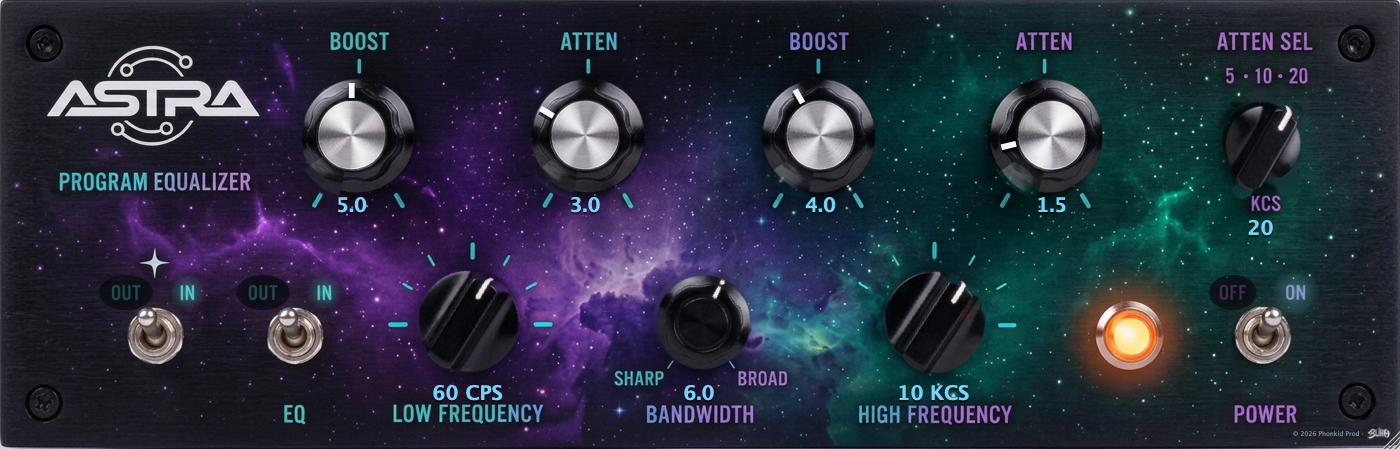
A passive valve EQ inspired by the ones from the 50s: a passive network, a valve that makes the level back up, and transformers. It's the one with the trick of boosting and cutting the lows at the same time, and here the trick gives what the hardware gave.
It's in the Astra Creative Audio subscription — if you're already in, it's yours without paying a cent more.
What it does
Lows: boost and cut with a knob each, at 20, 30, 60 or 100 Hz. Highs: boost from 3 to 16 kHz with its BANDWIDTH, from SHARP to BROAD, and cut at 5, 10 or 20 kHz. The knobs go from 0 to 10, with no units, like on the original.
Off the faceplate, in the ASTRA logo menu: a ±12 dB DRIVE into the valve — it raises what goes in and lowers what comes out by the same amount — output, MIX, M/S and the oversampling mode.
And what it doesn't have, on purpose: no mains hum and no hidden boost when you insert it. With everything at zero, the difference at 1 kHz is −0.004 dB; the only thing you notice is the transformer at the very top: −0.5 dB at 20 kHz.
What you get
It's included in the subscription. Anyone with Astra Sampler FX has it, and the subscription price doesn't go up because of it.
Or buy it on its own, if you only want the EQ: a one-off €35 + VAT, and it's yours. Not a subscription, not a licence that expires.
Why try it
Because we publish what we measure. These figures come from our test bench, which runs the same engine you download.
Boost and cut at once at 20 Hz: +3.00 dB at the bottom and a −2.00 dB dip at 310 Hz. That's what was measured on the hardware.
The difference between the two ends of the BANDWIDTH. On the hardware, 9 dB.
The worst of 12,600 curves between 20 Hz and 16 kHz, against the analogue prototype. At 96 kHz, 0.015.
The same in all three oversampling modes and with the EQ in or out.
The valve, measured at the factory spec level (+10 dBm): 0.151% THD, with the second harmonic leading. With the factory ×4 oversampling, aliasing stays at −85.7 dB with the EQ flat, for 1.62% of one core.
Where we don't win
At 44.1 kHz the error rises to 0.661 dB. Not a bug: it's what happens to a +19 dB bell between 12 and 16 kHz when there's no room above it. At 96 kHz it drops to 0.015.
We don't model the transformer's harmonic floor. The only thing backing it is a review with no frequency or level, and imitating it would mean adding hum and aliasing. The cure seems worse to us.
Formats and requirements
macOS: VST3 and Audio Unit, universal binary (Intel and Apple Silicon),
macOS 10.13 or later.
Windows: 64-bit VST3, Windows 10 or later. Mono and stereo, any sample
rate.
A heads-up: the installers aren't signed with a paid certificate, so macOS will say it can't verify the developer and Windows may show a SmartScreen warning. On macOS you approve it in System Settings → Privacy & Security; it's explained step by step on the download page.