Channel EQ · €35 + VAT or in the subscription
The A-Channel EQ: the highs where you ask for them
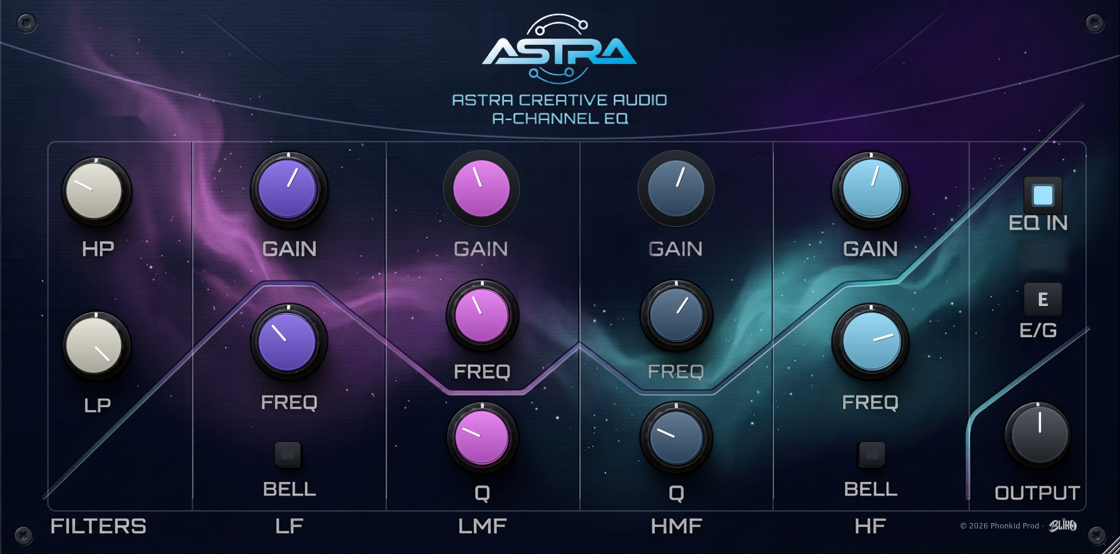
A four-band channel EQ with filters, inspired by the one in the great British consoles, with its two characters on a single button. And with something digital EQs struggle with: a bell at 16 kHz lands where you put it.
It's in the Astra Creative Audio subscription — if you're already in, it's yours without paying a cent more.
What it does
Four bands: lows and highs as shelves or bells, and two mids with adjustable Q. An 18 dB-per-octave high-pass and a 12 dB low-pass, like on the console.
The character button changes the shape of the bells: in one mode the bell widens at low gain — at +6 dB, 1.72 times wider — and in the other it stays narrow.
A classic digital EQ bends the top bells: the closer to 20 kHz, the more they get squashed. Here the curves are fitted to the analogue prototype, so a boost at 16 kHz sounds like a boost at 16 kHz. And no colour and no latency: with EQ IN off, the output is identical to the input, bit for bit.
What you get
It's included in the subscription. Anyone with Astra Sampler FX has it, and the subscription price doesn't go up because of it.
Or buy it on its own, if you only want the EQ: a one-off €35 + VAT, and it's yours. Not a subscription, not a licence that expires.
Why try it
Because we publish what we measure. These figures come from our test bench, which runs the same engine you download.
A +12 dB bell at 44.1 kHz against the analogue curve. A classic digital filter is off by 6.60 dB.
Across 723 cases against the analogue prototype; 98.3% stay under 0.25 dB.
No look-ahead and no oversampling: nothing shifts in the mix.
Of one core, at 48 kHz and a buffer of 64, with all four bands moving. The average, 0.2%.
At 8 kHz the same bell is off by 0.10 dB, and at 12 kHz by 0.27, where the classic filter is off by 1.58 and 3.62. The filters measure what they say: 18.00 dB per octave for the high-pass and 12.03 for the low-pass.
Where we don't win
The worst measured case is 0.685 dB: a high shelf at 16 kHz, at 48 kHz, looking at 13.4 kHz. Outside that corner, the worst is 0.315 dB.
It doesn't colour. It's a clean EQ. If you want it to get dirty, that's the A-Pre EQ's job.
Formats and requirements
macOS: VST3 and Audio Unit, universal binary (Intel and Apple Silicon),
macOS 10.13 or later.
Windows: 64-bit VST3, Windows 10 or later. Mono and stereo, any sample
rate.
A heads-up: the installers aren't signed with a paid certificate, so macOS will say it can't verify the developer and Windows may show a SmartScreen warning. On macOS you approve it in System Settings → Privacy & Security; it's explained step by step on the download page.