Rack of three EQs · €35 + VAT or in the subscription
The A-500: three EQs, and you choose the order
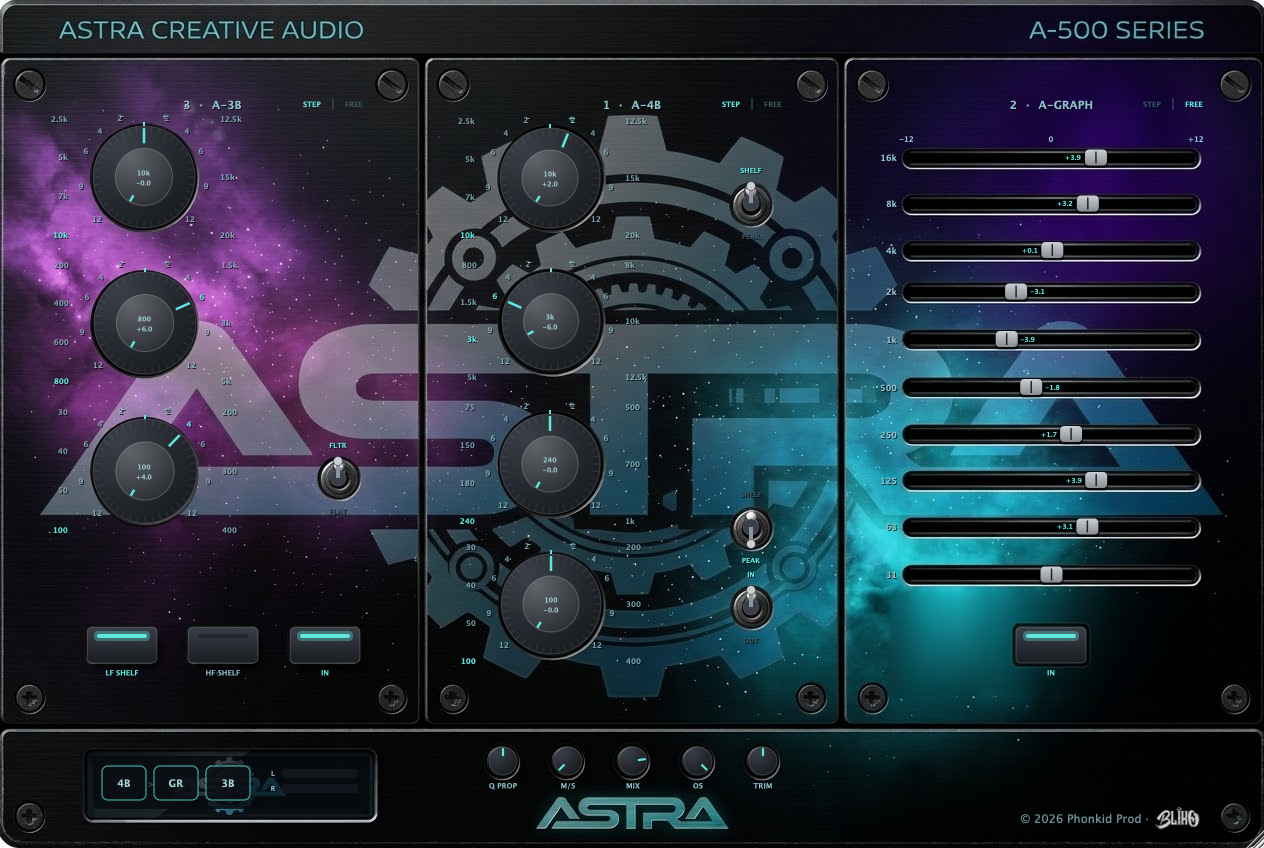
Three EQ modules in a single rack, always in series and in whatever order you want: a three-band one, a four-band one with overlapping bands and a ten-band graphic. Each module has its own amp stage, so the order changes the sound.
It's in the Astra Creative Audio subscription — if you're already in, it's yours without paying a cent more.
What it does
A-3B: three bands with frequency and gain on the same knob, a filter and shelves. A-4B: four overlapping bands, with lows and highs as shelves or bells. A-GRAPH: ten octave bands, from 31 Hz to 16 kHz. You change the order by dragging the three tiles on the display, and the change crossfades without a click.
Q PROP decides how much the bell tightens as the gain goes up: at 0%, fixed Q; at 100%, like the original; at 200%, twice as much. STEP snaps frequencies and gains to the factory positions; FREE leaves them continuous.
And on the bottom bar: M/S, MIX, oversampling and TRIM.
What you get
It's included in the subscription. Anyone with Astra Sampler FX has it, and the subscription price doesn't go up because of it.
Or buy it on its own, if you only want the EQ: a one-off €35 + VAT, and it's yours. Not a subscription, not a licence that expires.
Why try it
Because we publish what we measure. These figures come from our test bench, which runs the same engine you download.
In every mode, oversampling included: it's polyphase IIR, with no delay.
The third harmonic of a 15 kHz tone at −3 dBFS. Without oversampling, −15.1.
+12 and −12 dB at the same frequency cancel out from 20 Hz to 20 kHz.
The bell at +2 dB is 2.9 times wider than at +12. With Q PROP at 0%, 1.00×.
Each module's amp stage is almost inaudible at working level — 0.048% THD at −18 dBFS — and you notice it when you push: 0.67% at 0 dBFS. With everything flat, the rack is unity: −0.004 dB.
Where we don't win
With all ten graphic bands at +12 dB you don't get a straight line: there's 5.5 dB of ripple between 63 Hz and 8 kHz, because the bands overlap, like on the original.
At ×4 aliasing measures −96.4 dBFS, worse than at ×2. If you want the minimum, ×2.
Formats and requirements
macOS: VST3 and Audio Unit, universal binary (Intel and Apple Silicon),
macOS 10.13 or later.
Windows: 64-bit VST3, Windows 10 or later. Mono and stereo, any sample
rate.
A heads-up: the installers aren't signed with a paid certificate, so macOS will say it can't verify the developer and Windows may show a SmartScreen warning. On macOS you approve it in System Settings → Privacy & Security; it's explained step by step on the download page.